Language Journal #3: 5 days of Dutch

Ik spreek geen Nederlands, maar ik wil het leren, want ik wil naar Nederland en België gaan.
This past week I took a break from practicing Portuguese to try something new and different: Dutch. At the moment I’m not trying to diverge completely away from Portuguese, but I did want to try out some new learning methods.
I chose to look into Dutch because of the many similarities with English. Though the languages may not be as similar to each other as Spanish and Portuguese, I still think that it will not be a language completely foreign to me. Also, I’ve had my eyes on two universities for a while (an engineering one in Delft, and a theology school in Leuven).
For these first five days, I decided to use the Michel Thomas Method. This method consists of audio lessons where the listener is introduced to the structure and vocabulary of a language by translating phrases and sentences that increase in difficulty as the course progresses. I had heard a preview of their Russian course and was surprised at the quality and methodology it offered. With this in mind I decided to try out their Dutch course, and see how far I could get in 5 days.
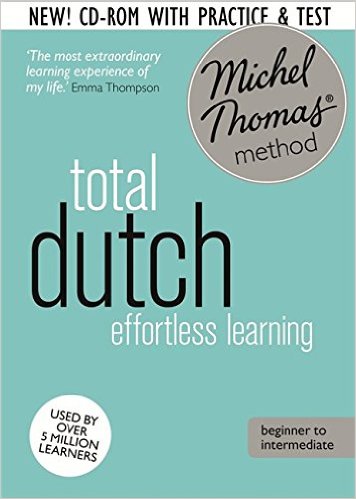
Here’s an overview of what my five days of Dutch looked like:
Day 1: On Day 1 I went through CD 1 of the Dutch Foundation course. I was introduced to the words het (it), is (is), and niet (not), along with several adjectives, adverbs, nouns, and pronouns. The structure was introduced for simple one-verb sentences, two-verb sentences, and questions. The pronunciation of the letters w, v, ie, oe, ij was also taught, which is different than English pronunciation.
Day 2: I went through CD2 of the Foundation course. The main focus of CD2 was in learning new verbs, like hebben (have) and kunnen (can). Several different sentence structures were introduced. The article de (the), and the pronouns hij (he), ze (she, they)
Day 3: CD3 of the Foundation course. CD3 showed different ways of expressing the future. In a way this is similar to English in that one of the forms of talking about the future is to use the verb gaan (going to). Another way of expressing future actions is to simply add a future adverb, like morgen (tomorrow).
Day 4: Day 4 was more of a break for me, since I went to the movies, ate out, and binge-watched Season 6 of The Walking Dead. I managed to listen through the first four tracks of CD4, and also did some writing exercises. Since Day 1, I’ve been writing down every single sentence that is mentioned in the audio courses (in Dutch only, without a translation). I want to get a feel of how to read Dutch, and this exercise seemed to help me. To make up for not going through CD4 completely, I started translating all of the sentences that I have written down these past few days. I managed to translate about 6 pages (however, these sentences are simple and also talk about the same topics). My plan is to finish this translation exercise, hopefully by tomorrow, and finish CD4, maybe start listening to CD5, and record a small clip of myself attempting to speak Dutch after 5 days.
Day 5: My goals for this final day were not completed. I went through several more tracks of CD4 and also completed 2 more pages of my translation exercise. However, after these first five days, my impression of the Michel Thomas method has been a very good one.
Overall:
Five days is definitely not enough for me to have a conversation, but the large amount of vocabulary and sentence-structure taught in the course was very helpful. At the moment, I feel confident with simply describing objects or situations. After 5 days, I definitely plan on continuing to learn Dutch through this method. In the future I’ll post my impressions of the Michel Thomas Dutch Foundation course once I finish going through all of their CD’s.